The Role of Memes in Modern Political Discourse
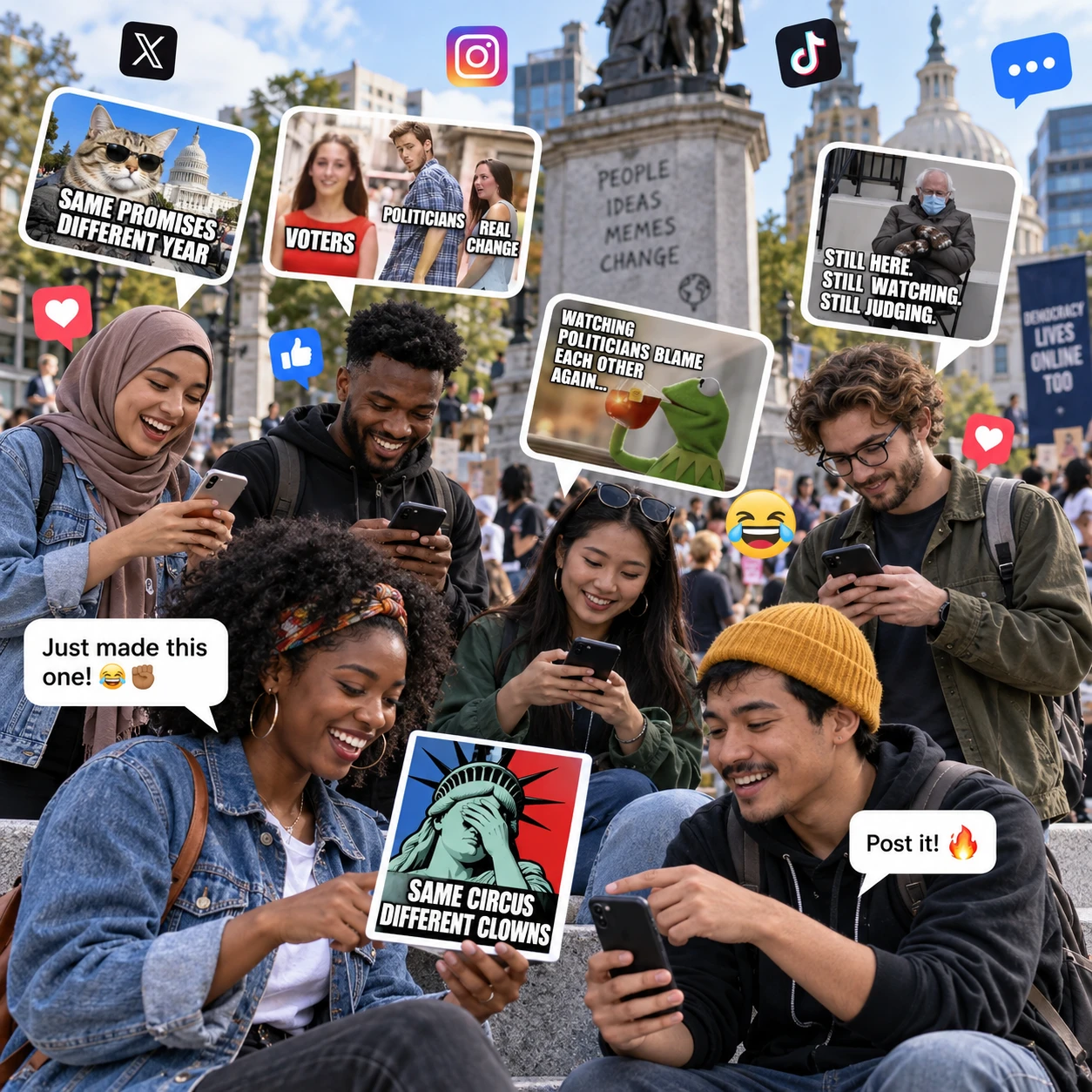
A political argument can take the form of a speech, an article, or a single image with a line of text. On social media platforms, that image may travel faster than the explanation behind it. Political memes have become a familiar part of modern political discourse because they compress commentary into material people can recognize, adapt, and share.
Their influence is real but hard to reduce to a single outcome. Memes can make political communication more accessible, invite civic engagement, and challenge authority. They can also strip away context, circulate misleading claims, and sharpen political polarization. Understanding how they work means looking at both the joke and the route it takes across the internet.
What Makes a Meme Political?
A political meme uses a familiar image, phrase, video, or format to comment on a political issue, person, institution, event, or belief. Its meaning comes from the combination of the content and the context audiences bring to it.
Some political memes are explicitly about elections, public policy, politicians, or government decisions. Others use a popular reaction image to express distrust, frustration, or approval without naming a party or candidate. A recognizable template lets a creator make a new point while relying on viewers to understand the reference.
That shared recognition is part of the message. A photograph may be cropped, captioned, or paired with another image to turn a serious event into political satire. A short video might be remixed to mock a campaign promise. The format often signals a stance before the viewer has examined the details.
Political memes are participatory: users can copy a template and change its words to fit a new controversy. This makes them different from a fixed editorial cartoon or official campaign ad. A meme may have no clear author by the time it reaches a large audience, and different communities can use the same format to argue opposite positions.
Why Memes Spread So Easily
Political memes spread easily because they are quick to recognize, simple to share, and often designed to provoke an emotional response. Their brevity suits social feeds where people scroll past more information than they can carefully assess.
Humor helps a message travel. A well-timed punchline can make a political criticism feel less like a lecture, while irony gives people a way to express skepticism or anger. Visual shorthand also reduces the effort needed to understand the basic point, especially when the image or phrase is already familiar.
Sharing adds another layer. On platforms such as Instagram, TikTok, Reddit, X, and Facebook, users can repost, quote, remix, or send a meme privately. Each action can bring it to a different audience, where it may be recaptioned or detached from its original conversation. Recommendation systems can also surface engaging posts to users beyond the creator’s immediate network, though platform algorithms and reach vary.
Virality is not the same as agreement or persuasion. Someone may share a meme because it is funny, because it signals group identity, or because they want to criticize it. A large number of views says little by itself about how many people believed the claim or changed their opinion.
Memes as Political Commentary and Criticism
Political memes let people react to public events, criticize powerful figures, and communicate viewpoints in a compact, often humorous form. They can turn a complex moment into a recognizable symbol, although that compression can leave out important details.
During a debate, policy announcement, protest, or government crisis, memes may appear within minutes. Some ridicule a politician’s public statement; others point to a gap between a promise and its consequences. Political satire can make criticism easier to approach and give ordinary users a visible way to challenge official messaging.
Memes also help people interpret events through shared references. A popular template can communicate “this feels familiar” or “I don’t trust this explanation” without a long post. That shorthand can build connection among people who already share a perspective. It may also make a political discussion harder to enter for those who do not know the reference or its history.
The same flexibility that supports criticism can blur intent. A meme might be sincere, sarcastic, or deliberately ambiguous. One audience may read a caption as a joke; another may treat it as a factual claim. Its effectiveness as commentary therefore depends on who sees it, what they already know, and whether the post links to evidence or merely gestures toward it.
From Sharing to Participation
Memes can contribute to political participation by giving people an accessible way to discuss public issues, express a position, and invite others into a conversation. They can prompt engagement, but sharing a meme alone does not show that someone has taken further civic action.
Creating a meme asks a user to choose a target, frame an argument, and decide what a particular audience will recognize. Circulating one can signal solidarity or encourage discussion among friends. In some cases, memes accompany broader activity such as organizing, fundraising, voter information campaigns, or protest communication. Their role is best understood as one part of a larger set of actions, not a substitute for those actions.
For example, someone might see a meme about a proposed local change, ask what the joke refers to, and follow the discussion to a council agenda or news report. Another person may share a voter-registration reminder because a visual post is easy to pass along. In both cases, the meme can open a door; reliable information and concrete opportunities are what help people move through it.
There are limits. Low-effort sharing can create the feeling of participation without helping anyone understand the issue. A joke may also crowd out details about deadlines, eligibility, or policy trade-offs. Memes work best for civic engagement when they point toward verifiable information or a clear next step.
Risks of Meme-Driven Discourse
Meme-driven discourse carries risks because humor and visual shorthand can simplify complex issues, hide the source of a claim, and remove context as content spreads. These problems do not make political memes inherently harmful, but they make careful interpretation necessary.
Oversimplification is built into many meme formats. A complicated policy debate may be reduced to a hero-and-villain story, leaving out legal, economic, or practical constraints. The result can be a memorable impression that is much easier to share than to correct.
Misinformation can travel in a joke as well as in a serious-looking post. A meme may use an authentic photograph with a false date, attribute a quote to the wrong person, or present a cropped chart that hides its source. Satire can be mistaken for news, and misleading posts can later be defended as “just a joke.”
Decontextualization changes meaning as posts move between platforms and communities. A screenshot may omit the original caption, date, or link. Even a genuine image can mislead when viewers do not know when or where it was made.
Memes can also reinforce political polarization. Content that ridicules an opposing group may strengthen in-group identity while making good-faith discussion less likely. But exposure does not automatically produce polarization, just as a viral joke does not automatically shift public opinion. Effects depend on the audience, the claim, and the wider political environment.
Reading Political Memes Critically
To read political memes critically, identify the claim, check the original context, assess the source, and look for evidence before sharing. A quick pause can separate a useful piece of political commentary from a post that only feels convincing.
- Translate the joke into a claim. Ask what the meme wants you to believe about a person, event, or policy. If you cannot state the claim clearly, do not treat the punchline as proof.
- Check the image and date. Search for the original photo, video, or statement. Look for when and where it appeared, and whether the caption matches the source.
- Find independent reporting or primary material. For a quote, look for a full transcript or recording. For a policy claim, consult the relevant document, official page, or credible reporting rather than relying on a screenshot.
- Consider the creator’s purpose. Is the post satire, persuasion, fundraising, or an attempt to provoke? The purpose does not settle whether a claim is true, but it helps explain how the meme frames it.
- Pause before reposting. If a meme relies on outrage, a startling statistic, or a cropped image, verify it first. Sharing uncertainty as fact can extend a misleading claim’s reach.
A useful rule is to separate the meme’s format from its evidence. A clever format may make an argument memorable, but it cannot establish that the argument is accurate. Political memes are most valuable when readers enjoy the satire and still ask what supports the point.