The Psychology Behind Viral Content: Why We Share, Watch, and Engage
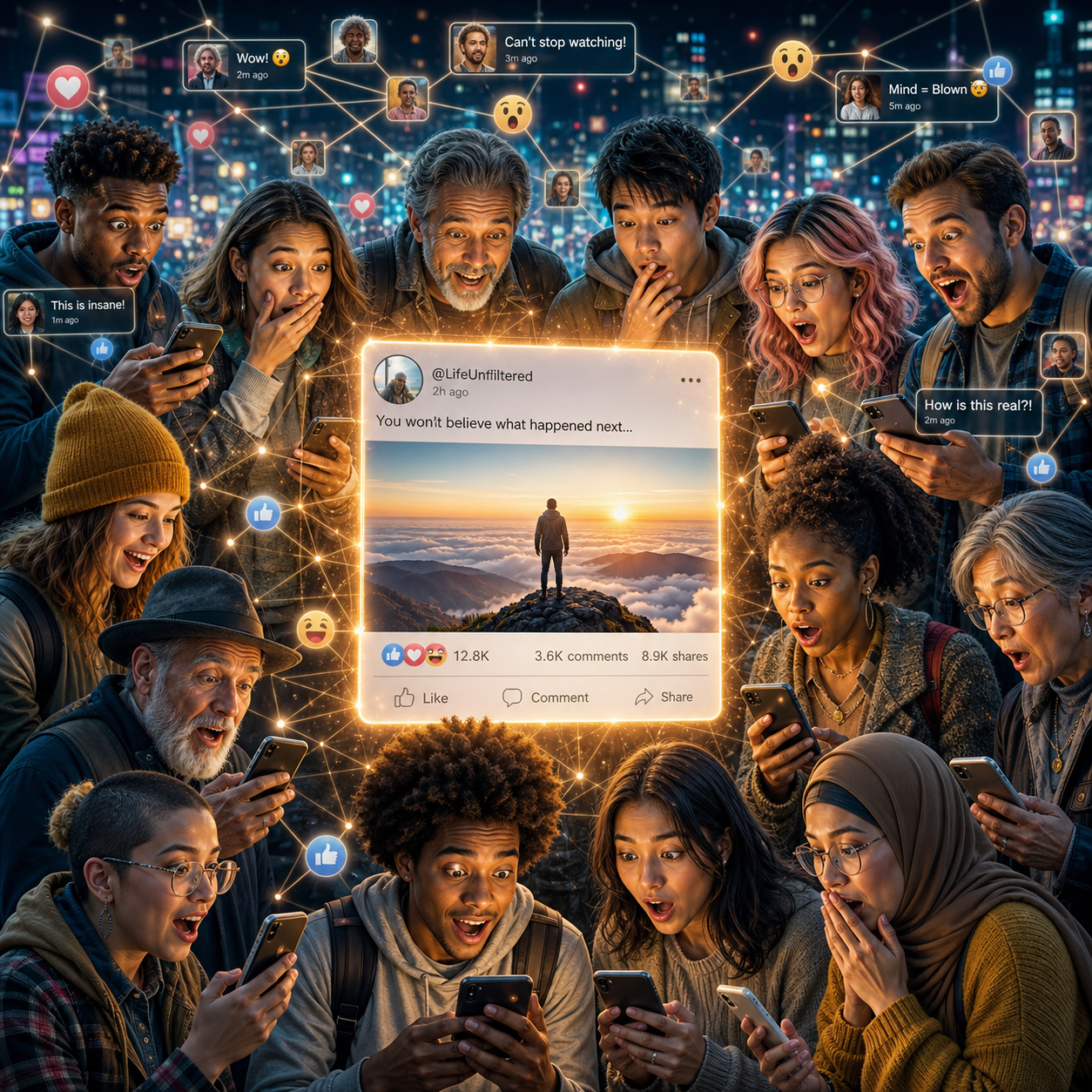
Viral content spreads rapidly because human psychology and platform design reinforce each other. A post, video, meme, or breaking-news clip gains momentum when it captures attention, triggers emotion, offers social meaning, and receives enough early engagement for recommendation systems to distribute it more widely.
That combination makes virality difficult to predict. A carefully produced explainer may disappear while an improvised reaction becomes unavoidable. Popularity can reflect genuine interest, coordinated activity, algorithmic amplification, or simple repeated exposure. Understanding the psychology behind viral content helps us interpret those outcomes without confusing visibility with truth or value.
What Makes Content “Viral”?
Viral content is material that achieves unusually rapid and extensive circulation through sharing, discussion, mass engagement, and platform distribution. Organic sharing begins with people passing content to one another, while algorithmic amplification increases its reach through recommendation systems, trending feeds, search results, and autoplay.
Virality has several overlapping forms. A meme may spread through private messages and group chats before public metrics reveal its reach. An outrage clip may receive millions of views because users comment to criticize it. A breaking-news post may travel through journalists, eyewitnesses, and ordinary users at the same time.
These examples show why a high view count does not explain itself. Content can become prominent because people find it useful, entertaining, emotionally powerful, politically relevant, or simply impossible to avoid. The most useful question is not only, “How many people saw this?” but also, “What process put it in front of them?”
Virality is better understood as momentum than as a permanent quality. Attention rises when emotional response, social sharing, cultural timing, and platform distribution align. It can collapse just as quickly when interest fades, new information appears, or users stop rewarding the content with watch time and interaction.
Emotion Is the Engine of Sharing
High-arousal emotion often drives sharing because intense feelings create a need to react, communicate, or involve someone else. Surprise, amusement, anger, awe, and anxiety can all increase the likelihood that people will pass content along, although emotion alone never guarantees virality.
Low-intensity feelings may encourage quiet appreciation, but high-arousal states demand attention. A startling discovery can produce surprise. A beautiful scientific image can inspire awe. A ridiculous video can create amusement. An injustice clip can provoke anger, while an alarming rumor can generate anxiety. Each emotion supplies energy for action, even when the action is a warning or criticism.
The reason for sharing differs by emotion:
- Amusement: People share jokes and memes to create a moment of connection.
- Surprise: Unexpected information feels worth reporting to others.
- Awe: Extraordinary scenes invite people to witness something larger than ordinary experience.
- Anger: Outrage can signal injustice and recruit others to a perceived cause.
- Anxiety: People may circulate uncertain information as a warning, even before verifying it.
Emotion also affects memory. A calm article may be accurate yet difficult to recall, while a dramatic headline remains mentally available. That availability can make content feel more important than it is. Repeated emotional exposure may also normalize extreme framing, especially when users encounter similar messages across several platforms.
This creates a serious trade-off: emotional intensity can make communication vivid and socially useful, but it can also reward exaggeration. A viral post may accurately express a public mood while presenting weak evidence. Feeling strongly is information about the audience’s reaction, not proof that the claim itself is correct.
The Social Reasons People Share Content
People share content to manage relationships, express identity, gain social currency, and participate in group life. A share can communicate, “This is useful,” “This represents me,” “I want you to see this,” or “People like us should pay attention.”
Social currency refers to the status or relational value people gain from passing along interesting, funny, timely, or exclusive information. Sharing an obscure meme may make someone appear culturally informed. Posting a clear explainer can signal competence. Circulating a personal story can invite empathy and deepen connection.
Identity signaling works in a similar way. Users select content that reflects political beliefs, taste, profession, community, humor, or moral priorities. A climate explainer, a sports celebration, a satirical post, and an outrage clip may all function as identity statements. The content tells others where the sharer stands, sometimes more clearly than a direct declaration would.
Sharing also supports belonging. Group behavior becomes easier when a common object, phrase, image, or controversy gives people something to discuss. A challenge, recurring joke, or widely recognized clip can act as a social password. People join partly because participation reduces the distance between themselves and the group.
Connection is not always benevolent or harmonious. Users may share content to attack an opposing group, demonstrate loyalty, seek approval, or strengthen boundaries. Confirmation bias can intensify this pattern: people notice and circulate information that fits what they already believe, while discounting material that threatens their worldview.
One practical test is to ask what a share is doing socially. Is it transferring information, offering entertainment, expressing identity, building intimacy, seeking status, or recruiting allies? The same post can perform several functions at once.
Curiosity, Attention, and the Structure of Viral Content
Viral content often holds attention by combining a clear hook with incomplete information. A curiosity gap appears when people know enough to recognize a question but not enough to feel satisfied, encouraging them to watch, read, click, or continue.
Effective hooks can take many forms: an unusual outcome, a surprising comparison, a bold claim, a visible mystery, or a personal conflict. The hook creates an information imbalance. The audience expects that the missing explanation will arrive if it keeps going.
Narrative transportation strengthens this effect. When people become absorbed in a story, they temporarily focus less on the surrounding environment and more on the events, characters, and emotional stakes inside the narrative. Personal stories, transformation videos, investigative threads, and short suspense clips use this structure even when they last only a few seconds.
Viral formats commonly rely on:
- Novelty: Something feels new, unusual, or newly relevant.
- Clarity: The premise can be understood quickly while scrolling.
- Tension: A question, conflict, or unresolved outcome keeps attention active.
- Relatability: Viewers recognize their own experience in the situation.
- Payoff: The ending delivers an answer, reveal, joke, lesson, or emotional release.
These features work differently across media. A meme depends on rapid recognition and remixability. An explainer needs enough structure to reward sustained attention. A personal story may spread because its emotional arc makes private experience feel publicly meaningful. None is a guaranteed formula; cultural context and timing still decide whether the structure resonates.
Social Proof, FOMO, and the Viral Feedback Loop
Social proof accelerates virality by making visible popularity seem like evidence that content deserves attention. Likes, shares, comments, view counts, trending labels, and familiar accounts can persuade people to join an activity they might otherwise ignore.
The feedback loop is straightforward:
- A small audience reacts to content.
- Visible engagement signals relevance to additional users.
- Those users watch, comment, or share it.
- Platforms detect stronger interaction and distribute it further.
- Repeated exposure makes the content feel increasingly familiar and important.
FOMO, or the fear of missing out, adds urgency. Users may watch a trending clip because everyone seems to be discussing it, join a challenge before it fades, or share a developing story so they remain part of the conversation. Participation becomes a way to avoid social exclusion.
Repeated exposure has a second effect: familiarity can feel like credibility. Seeing a claim across multiple posts may make it seem established, even when those posts trace back to one unverified source. This is why visibility should be separated from verification. Popularity measures attention; it does not independently measure accuracy.
Algorithms, Group Behavior, and the Illusion of Organic Virality
Algorithms and recommendation systems influence virality by selecting what users see, when they see it, and how often it returns. They interact with human behavior rather than replacing it: early reactions create signals, platforms rank those signals, and increased exposure produces more reactions.
Recommendation systems commonly use behavioral indicators such as viewing time, completion, repeat viewing, comments, shares, follows, and rapid interaction. The exact weighting varies by platform and changes over time, so no outsider should treat any single metric as a universal rule. The important point is that platform visibility is filtered through prediction systems designed to estimate what may hold attention.
Group behavior amplifies this process. Once a crowd gathers around a post, users infer that the object matters. They may imitate the crowd, challenge it, or join simply to understand the controversy. A critical comment can therefore contribute to distribution just as an approving one does.
This produces the illusion of organic virality. Content may appear to have spread naturally from person to person, while platform ranking, creator networks, coordinated posting, paid promotion, or recommendation placement helped create the initial conditions. Organic interest can still exist, but it operates inside an engineered environment.
There is also a feedback problem. Algorithms learn from past engagement, and users adapt to what receives attention. Over time, creators may intensify emotional language, shorten explanations, or foreground conflict because those choices perform well. The result is a media environment where human preferences and platform incentives continuously shape one another.
Reading Viral Media More Critically
To read viral media critically, separate the content’s emotional appeal, social function, evidence, and distribution path. This framework helps you understand why something is spreading without treating its popularity as proof.
Use four questions when examining a viral post or trend:
- What emotion is activated? Look for surprise, amusement, anger, awe, anxiety, or a mixture of feelings.
- What identity does sharing express? Consider whether the post signals group membership, expertise, taste, morality, or opposition.
- What information is missing? Identify the curiosity gap, omitted context, unclear source, or unresolved claim.
- What is driving distribution? Check whether discussion, social proof, recommendation systems, repost networks, or FOMO may be increasing visibility.
Then apply a basic evidence check. Find the original source, distinguish eyewitness material from commentary, check dates and edits, compare independent reporting, and ask whether the headline accurately represents the underlying content. A viral breaking-news post deserves more verification, not less, because speed increases the chance of error.
Two common analytical mistakes deserve attention. The first is treating controversy as proof of manipulation. Controversial content can spread because it exposes a real conflict, but it can also be engineered to provoke engagement. The second is treating emotional content as automatically irrational. Emotion can draw attention to genuine harm or shared experience; the key issue is whether the evidence supports the conclusion attached to that emotion.
Virality can be deliberately engineered through timing, narrative design, coordinated distribution, and platform-aware formatting. Yet engineering does not guarantee a cultural response. People still decide whether content feels relevant, expressive, funny, threatening, or worth passing to someone else. The psychology behind viral content is therefore best understood as an interaction among minds, groups, media forms, and machines.
Frequently Asked Questions About Viral Content
Why do emotional posts go viral?
Emotional posts go viral because high-arousal feelings increase attention, memory, and the urge to communicate. Anger, amusement, surprise, awe, and anxiety can all motivate sharing for different social reasons.
Does controversial content spread faster?
Controversial content can spread quickly because disagreement produces comments, quote-posts, reactions, and group mobilization. However, controversy is not a guarantee; unclear claims, weak timing, or limited audience relevance can stop momentum.
How do algorithms influence virality?
Algorithms influence virality by ranking and recommending content according to predicted engagement signals such as viewing time, completion, interaction, and sharing. They can magnify early human interest and make content appear more organically widespread than it was.
Why do people share content they do not fully believe?
People may share uncertain content as a warning, joke, question, identity signal, or invitation to discuss it. Sharing does not always mean endorsement, although audiences can interpret it that way.
Can viral content be deliberately engineered?
Creators and organizations can design for attention, curiosity, emotional response, and social participation, and they can coordinate distribution. They cannot fully control cultural timing, audience interpretation, or whether users decide to share.